Digital archive of Šechtl & Voseček Studios
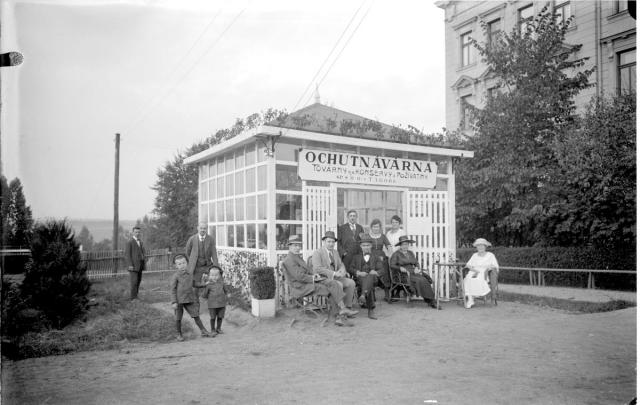
The most popular pavilion at the 1920 Exhibition was the "tasting pavilion" of the cannery and edible goods factory.
- ID:
- desky/deska0518
Order print from this photograph - Name:
- The most popular pavilion at the 1920 Exhibition was the "tasting pavilion" of the cannery and edible goods factory.
- Description:
- Finale of the Horticultural and Fruit-Growing Exhibition. We are written to: “Gone are the blissful days of Aranjuez!” (Don Carlos, Act I, Scene I.) The memories of the “Tasting Pavilion” will never disappear from the minds of those who took part. It became an irresistible magnet for every stratum of the public. The Madeilon served there successfully rivalled Praveček’s Madeilon. Anyone observing the psychology of the crowd could see that its favour turned toward distillates rather than fruit juices. Inside the pavilion could be seen representatives of local government, rendered speechless by a mixture of Madeilon with cognac or slivovitz; representatives of the press, who were completely “zmocněni”; small representatives of the tobacco monopoly, who gladly spent their hard-earned money; representatives of barbers and wigmakers, who in their misery immersed their spirits in Nirvana; “pajdagogové” who “do not want goods, but money”; and lovely ladies acquiring a mood more than rosy. Here and there legs could be seen sticking out of the bushes, while the nobler part of the body was hidden from eyes and from the moon. Golden pavilion! What it did on Monday, however, surpassed all bounds of imagination. Its levelling influence reconciled quarrelling souls, religious and political opinions, evened out social differences, and stopped before neither sex nor age. All the participants united in destroying alcohol until three in the morning. Youths, even under fourteen, and the older hopes of the republic could be seen in the street “dřeli kozla”, “honili davida”, laughing into the gutter, “okrádali jinou část těla”, and yelling in an Indian fashion at invisible enemies. Where we had gladly listened to the harmonious tones of Praveček’s boys, a “držkant” now held sway, rising vertically as far as the Pleiades, its length and drawn-out quality merging with eternity. Everything drank and got drunk into speechlessness. And that was an undignified finale to the exhibition. — I expect that voices from the public will appear in Č. J. wishing that the pavilion and its contents not be abolished. For now that alcohol has already been half destroyed, this would entail an incomparable loss. Preserving the pavilion would also benefit industry: a new factory could be founded for the production of “opilčí koží”.
— Týdeník Tábor, 15 October 1920 - Automatic description:
- A group of adults and two children sits and stands in front of a small glazed exhibition pavilion. A large sign hangs above the entrance, with low fences, shrubs, and a garden path around the pavilion.
- Year:
- Author:
- Šechtl & Voseček archive(no closer identification)
- Keywords:
- botanical garden, exhibition, Tábor
- Automatic keywords:
- výstavní pavilon, skupina lidí, children, nápis, way, plot
- Material:
- negative13x18
- Categories:
- Tábor
- Texts on the photo:
- OCHUTNÁVÁRNA,TOVÁRNY na KONSERVY a POŽIVATINY
- Location:
This is automatically generated preview from raw scan. The quality of automatically generated previews might vary. The images are scanned in 16-bit depth and high resolution and it is possible to tune them, retouch the scratches and make details. See the galeries.

Email us, if you have some additional informations about the photograph or if you are interested in the other use of the photograph.
All rights reserved, the copyright owner is © Marie Michaela Šechtlová. Photo archive is maintained by Jan Hubička