Digital archive of Šechtl & Voseček Studios
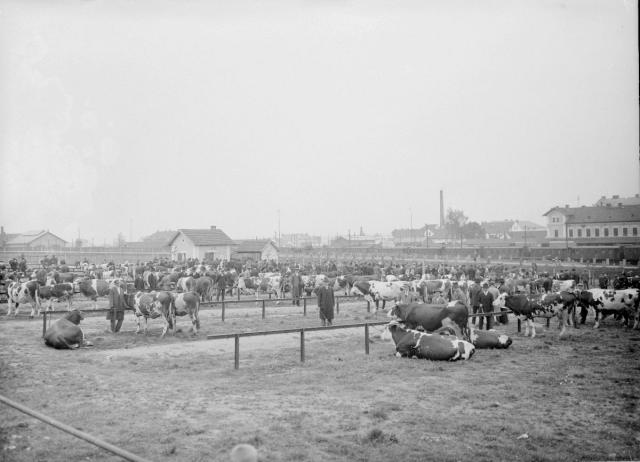
Cattle market
- ID:
- desky/deska5465
Order print from this photograph - Name:
- Cattle market
- Description:
- The cattle market was located at the corner of Vožická / Blanická streets. The little building with the booth is nothing other than the cooperative weighbridge. Cattle and carts loaded with hay (grain) were weighed here. Kovošrot Praha stands on this site today. In this form it existed until about 1965. Although it had long since ceased to serve its purpose, it was a place where circuses arrived every year or where fairground festivities took place.
I do not think this is an exhibition, but a cattle market. My parents and grandparents said that famous cattle markets were held here, from which they also profited because they owned an inn. The markets took place every month from April to October. It was quite an important location for the town. Farmers came here from a wide surrounding area (the Vožice, Sedlčany and Jistebnice areas); among others, this was where Tábor butchers came for meat.
If you are interested in the more colourful details about this place, this trade was controlled (by mafia-like methods) by farmers from Dub near Ratibořské Hory. It all ended with the Nazi occupation. Even so, the farmers did not give up. They drove cattle through the forest towards Tábor and slaughtered them at an agreed place (and time) near Záluží. Women waited there and then smuggled the meat into the town by various ingenious methods in order to avoid the revenue guards. One of the aerial bombs also fell here when the Americans bombed the railway station.
The chimney in the background stood in the stonemasonry works on Zavadilská Street, where there was a steam saw for cutting stone blocks. The Tábor heating plant was built 25 years later. In the background is the old railway station, which was much closer to Vožická Street. It acquired its present form and was rebuilt during the war, when the depot was also built, the bridge over the station was lengthened, and more tracks were added... Jiří Čikeš - Year:
- Author:
- Šechtl & Voseček archive(no closer identification)
- Keywords:
- zemědělství, cow
- Material:
- negative11x8.5
- Categories:
- Working, Events
- Texts on the photo:
- Location:
- 21
This is automatically generated preview from raw scan. The quality of automatically generated previews might vary. The images are scanned in 16-bit depth and high resolution and it is possible to tune them, retouch the scratches and make details. See the galeries.

Email us, if you have some additional informations about the photograph or if you are interested in the other use of the photograph.
All rights reserved, the copyright owner is © Marie Michaela Šechtlová. Photo archive is maintained by Jan Hubička