Forgotten Colours of the Past

An exhibition of the Šechtl & Voseček Museum of Photography


Digital Reconstruction of Early Colour Photography

The English version of the exhibition newspaper is being prepared. Photographs and other illustrations will be added to the web edition as preparation of the exhibition continues.

A full English translation of the exhibition newspaper will be added before the web exhibition is published.

When Was Colour Photography Born?

Colour photography is older than most of us imagine. And at the very beginning there is already a problem: there is no single correct answer to the question of who invented it. Many histories begin with Maxwell’s demonstration of 1861, because his three-colour principle leads directly towards modern photography. The French specialist in historic photographic processes Bertrand Lavédrine, together with recent research into surviving materials, places Edmond Becquerel and his photographs of 1848 at the beginning of the story instead. The history of colour is therefore rather like a relay race: each pioneer solved a different part of the problem.

Becquerel: The First Colours That Could Not Face the Light

In 1848 the French physicist Alexandre-Edmond Becquerel prepared a layer of silver chloride on a silvered plate and succeeded in recording the solar spectrum approximately in its own colours. This was neither a hand-coloured photograph nor three images combined together: the colour was produced directly in the photographic layer by the action of light. Several plates survive — including a photograph of the spectrum in the Musée Nicéphore Niépce. The coloured bands remain clearly visible on an image more than 170 years old.

Becquerel had discovered the process before he could explain why it worked. When he asked in 1848 how the coloured image of the solar spectrum could be explained, his disarming answer was “Je l’ignore…” — “I do not know.” Scientists continued to debate the origin of the colours for more than a century and a half; modern analyses have shown the key role played by nanoparticles of metallic silver in the silver-chloride layer.

The practical problem was worse: the image could not be properly fixed. In light the plate continued to react, darkened and lost its colours; in darkness, on the other hand, the colours could survive for a very long time. Becquerel could create colour, but he could not persuade it to stay. Nevertheless, in Paris in 1855 he exhibited a colour photograph of a parrot. Its brightly coloured plumage was an attractive subject for demonstrating the new technique, but the photograph could not be exposed to daylight. According to the photographer Nadar, visitors crowded around a small darkened cabinet and were admitted one at a time; the parrot was illuminated only by the flame of a lamp. Nadar remembered grey, blue and red tones of “remarkable intensity”, which unfortunately did not last. The photograph acquired the nickname le perroquet susceptible — “the sensitive parrot”. The parrot was fortunate in the end: the photograph survives and is now held by the Muséum national d’histoire naturelle in Paris.

Hillotypes: A Fraud That Wasn’t Entirely a Fraud

Only a few years later, the American Baptist minister and daguerreotypist Levi Hill announced that he too could photograph in “natural colours”, as colour photography was then called to distinguish it from hand-colouring. In 1851 he caused considerable excitement — and then kept his process secret, promised further demonstrations and repeatedly asked for more time. Photographers became impatient; some complained that customers were postponing ordinary portraits because they were waiting for the new colour ones.

Hill published photographic manuals, and his opponents claimed that the colour miracle was merely publicity to sell books. In 1856 he finally offered, for the then astonishing price of 25 dollars, a volume entitled A Treatise on Heliochromy, promising a “full, plain, and unreserved” description of the Hillotype process. One attractive legend should be corrected here: the instructions really are in the book. They are simply an eleven-step chemical marathon buried in 175 pages of autobiography, photographic history, additional recipes and polemics. Modern researchers at the Smithsonian and Getty later described the published procedure as a possible “smokescreen”.

Even that does not end Hill’s story. Analysis of surviving plates showed that some colours were genuinely produced photographically, while others had been helped along with pigments applied by hand. The process was therefore not a pure fraud — it simply could not do everything its inventor claimed. Hill achieved the rare distinction of being both a pioneer and something of a fraud at the same time. When chemistry was not quite convincing enough, the brush occasionally came to the rescue.

Maxwell: The Right Principle and a Little Luck

If Becquerel could create colour without fully understanding why, James Clerk Maxwell found himself in almost the opposite situation: he had the right theory, but photographic materials were not yet ready for it. In 1861 he asked the photographer Thomas Sutton to photograph a tartan ribbon three times — through red, green and blue filters. The three black-and-white images were then projected through corresponding filters onto the same place. A colour image of the ribbon appeared on the screen.

The plates themselves remained black and white; the colour existed only when their images were optically combined. Yet this is the principle on which displays and much of colour photography still depend. History adds a small joke: the collodion plates of the period were almost blind to red light, so the experiment should not have worked as well as it did. The red areas of the ribbon were probably helped by the emulsion’s sensitivity to ultraviolet radiation. Maxwell had the correct theory — and his most famous experiment also had a little luck.

Ducos du Hauron: Three Images Move onto Paper

Maxwell’s colour image existed only while three projections were correctly superimposed. In 1868–1869 the French inventor Louis Ducos du Hauron described how three colour separations could be turned into three pigment images and combined into a single colour photograph on paper. Charles Cros arrived at related ideas at almost the same time. Colour no longer had to exist only on a projection screen.

For our story, an even more important idea of du Hauron’s was to fit all three colour components into a single image by means of a fine colour screen. The technology of his time was not yet capable of making this practical, but the idea was there. Several decades later it developed into the family of additive screen processes to which this exhibition is devoted.

Vogel: Teaching the Photographic Plate to See Colour

Three-colour theory had a serious enemy: the photographic plate itself. Ordinary silver emulsions readily recorded blue and violet, but responded badly, or scarcely at all, to green, yellow and red. In 1873 the German photochemist Hermann Wilhelm Vogel showed that suitable dyes could extend the sensitivity of silver bromide into other parts of the spectrum. This discovery was crucial to practical colour photography. The black-and-white plate did not become coloured; it simply began to respond to colours that it had previously been almost unable to see.

Ives: Chlorophyll and the Kromskop

The American inventor Frederic Eugene Ives approached Vogel’s problem by a rather botanical route. From 1879 onwards he published a method in which collodion-bromide plates were sensitised with chlorophyll obtained from periwinkle leaves or related plants. The chlorophyll did not turn the photograph green; it helped the emulsion respond to a wider range of visible light. Ives could therefore translate coloured objects into black-and-white records more faithfully and use such plates for three-colour separations.

In his autobiography Ives recalled that hardly anyone took his first publication seriously. Years later he asked one professor why, and was reportedly told that the claim had sounded so incredible that he had regarded its author as a “self-deluded crank”.

More important still was Ives’s Kromskop. A special photograph contained three black-and-white records of the colour components, and an optical instrument recombined them into a full-colour image. It used three coloured glass filters — red, green and blue — and two semi-transparent mirrors, rather like a conjuring trick. Ives later also produced a stereoscopic version. In his memoirs he describes viewers covering a real coloured object placed beside the Kromskop with their hands, to make sure that the image inside the instrument was not merely a reflection. The catch was simple: without the Kromskop, the photographic record itself remained black and white.

Lippmann: A Nobel Prize for a Beautiful Dead End

The French physicist Gabriel Lippmann tried to bypass the entire three-colour problem. During exposure he placed a mirror of liquid mercury behind an exceptionally fine photographic emulsion. The incident and reflected light formed standing waves in the layer, leaving after development a microscopic structure that, under suitable illumination, reflected the corresponding colours again. No coloured dyes and no screen were required — colour was encoded in the structure of the emulsion itself.

It was a physically beautiful method, and Lippmann received the 1908 Nobel Prize in Physics for it. But exposures were long, manufacture was difficult, photographs were hard to copy and the colours had to be viewed under suitable conditions. Lippmann thus created one of the most elegant techniques in photographic history — and at the same time one of its most beautiful technological dead ends. Lippmann photographs are represented in the collections of the National Technical Museum in Prague; the development of colour photography forms part of its permanent Interkamera exhibition.

Miethe: When Three-Colour Photography Began to Work

Adolf Miethe was a German photochemist, optician and practically minded designer. Together with the chemist Arthur Traube he developed a new panchromatic sensitiser that greatly increased photographic sensitivity in the red part of the spectrum. Their patent of 1902 explicitly built on Vogel’s earlier use of cyanine: despite all the disputes, discoveries were accumulating one on top of another.

Miethe also designed a three-colour camera, manufactured for him in Berlin by Wilhelm Bermpohl. Three black-and-white photographs were made in succession on one elongated plate through different colour filters. The results could already be remarkably good, but the exposures followed one another. The camera could record colour — provided that the world was willing to stop moving for the duration of three exposures.

By about 1903 the principal pieces of the puzzle were therefore in place: a correct three-colour theory, photographic plates sensitive to a broad part of the spectrum, and practical cameras. The remaining problem was simplicity — one colour picture still required three precisely corresponding records.

How Can Three Colours Be Hidden in a Single Photograph?

When we left Miethe’s three-colour camera in the previous article, the basic problem of colour photography had, in a sense, already been solved. But a single colour image still required three black-and-white records, which then had to be recombined using three projectors or a special viewing instrument.

Screen processes offered a simple trick: instead of separating the photograph into three exposures in time, they divided it spatially into thousands or millions of microscopic areas. A fine colour filter — regular lines, small squares, or a random mosaic of coloured elements — was placed in front of a panchromatic black-and-white emulsion. Each tiny part of the emulsion therefore received information about only one region of the spectrum. After processing, the silver image acted as a microscopic mask; viewed through a corresponding colour screen, the separate points blended in the eye into a colour image.

Joly, McDonough and the Dispute over Coloured Lines

One of the first people to manufacture such a system convincingly was the Irish physicist John Joly of Trinity College Dublin. He patented his screen in Britain in 1893, and by the middle of the decade the system had entered practical use. One screen was used for exposure and another for viewing the positive. A colour photograph could therefore be taken with a single press of the shutter, but it required something that would become the curse of all separate-screen systems: almost perfect registration between the black-and-white transparency and the viewing screen.

Who invented it first? Here history quickly turns into a patent argument. Ducos du Hauron had described the principle of a microscopic colour screen as early as the 1860s, but did not have the technology to manufacture one reliably. The American James William McDonough filed patents in 1892 for a photographic colour screen made from a random mosaic of coloured particles. Joly then produced a practical screen of regular lines. McDonough soon abandoned his original granular system and moved to lines very similar to Joly’s, only finer. Their dispute makes the real difficulty very clear: the problem was not imagining a colour screen, but manufacturing it accurately, cheaply and on a large scale. Joly’s and McDonough’s ruling machines were slow and could produce only a few large screens per day. The process remained too expensive for genuine mass use.

Autochrome Lumière: A Colour Mosaic Made from Potato Starch

The brothers Louis and Auguste Lumière — today remembered chiefly for the cinematograph — had one great advantage over individual inventors: they already operated one of Europe’s largest photographic-plate factories. Instead of ruling a regular grid, Louis Lumière used randomly distributed microscopic particles — grains of potato starch dyed orange, green and violet. The patent was filed in 1903, the process was publicly demonstrated in 1904, and after several more years of development Autochrome reached the market in 1907.

The grains were only about 12 to 15 micrometres across. Three dyed batches were mixed and spread as a single layer on glass; the gaps were filled with fine carbon-black powder to prevent unfiltered white light from passing through. A panchromatic black-and-white emulsion was then coated over the screen. Millions of miniature colour filters therefore worked side by side on an ordinary plate.

In 1907 this became the first industrialised and commercially successful colour-photography process. Estimates suggest that around twenty million Autochrome plates were made during the following decades. Every Autochrome was also a unique physical original: the random colour screen and silver image were united on the same plate, and their exact structures belonged together. Copying was difficult, and damage or fading of the screen directly altered the colours of the picture.

Paget and Finlay: A Screen That Could Be Removed

The British Paget and Finlay processes worked rather like Joly’s plates. A colour screen was placed in the camera in front of an ordinary panchromatic plate — a photographic plate sensitive to most of the visible spectrum. The exposure produced a black-and-white negative in which colour information was encoded in the fine structure imposed by the screen. Several positives could be made from the negative and each combined with a viewing screen. One taking screen could therefore serve for many photographs, and a single negative could yield several colour copies. Regular screens were also more transparent than Autochrome and consequently required shorter exposures.

Clare Livingstone Finlay devoted many years to the development of colour processes. One of the first British systems was the Thames Colour Screen, sold from 1908. Its pattern consisted of red and green circular elements surrounded by blue. This branch of development was followed by the Paget Color Screen, introduced in 1913 by the Paget Prize Plate Company; it used a regular array of tiny coloured squares. In 1929 the system returned to the market in an improved form as Finlay Colour. The removable screen offered a major advantage over Autochrome: photographs could be copied. The disadvantages remained high cost and the need for extremely accurate registration.

Finlay himself presents a small historical detective story. The erroneous name “Clare Elizabeth Finlay” still circulates online. Patent documents are unambiguous: the inventor was Clare Livingstone Finlay. Surprisingly little reliable and easily accessible information about his life survives. His system nevertheless reached the royal court: Finlay Colour Ltd. is credited on official colour portraits of King George V and Queen Mary made in 1935, and photographs of the royal family using the process appear repeatedly. The photographer Oscar Jordan used the same system to photograph the American presidents Herbert Hoover and Franklin D. Roosevelt.

Dufaycolor: The Screen Moves into Film

The French inventor Louis Dufay developed his own regular screen before the First World War. His Dioptichrome used a geometric pattern of coloured lines and existed in versions with both integral and removable screens. The first life of the process was relatively short. Its second act is much more interesting.

From the mid-1920s the British company Spicers invested in the process. Technical development was led by Thomas Thorne Baker and the French engineer Charles Bonamico together with Dufay. Their work produced Dufaycolor on a flexible film base. The colour screen no longer had to be a glass plate in a camera holder; it could pass through a camera or cine camera as 16 mm or 35 mm film. Roll-film versions were also manufactured. Dufaycolor became the most successful attempt to transfer the classic microscopic-screen principle to cinematography. During the 1930s copying was substantially improved and a negative-positive method was introduced, although copies remained one of the weaker aspects of the system. Colour film of the coronation of George VI in 1937 made a strong impression on both the public and the film industry. Thorne Baker provides another attractive side story: he also worked on transmitting pictures at a distance, wrote Wireless Pictures and Television, and in 1930 lectured to the Television Society on television in natural colours.

Kodachrome and Agfacolor: The Screen Loses to Layers

In the middle of the 1930s a competitor appeared that would eventually drive regular colour screens out of ordinary photography. Kodachrome reached the market in 1935 and Agfacolor Neu in 1936. Instead of arranging the three colour components side by side in a mosaic, they stored colour information in several sensitive layers one above another. The final image was formed by subtractive cyan, magenta and yellow dyes. Kodachrome created its dyes during a complex processing sequence, while Agfacolor incorporated the necessary colour-forming components directly in the emulsion layers.

The transition can be seen particularly clearly in National Geographic, which used several competing systems simultaneously during the 1930s. In 1938 it printed 222 Finlay Colour photographs, 69 Dufaycolors and only 62 Kodachromes. A year later the figures were 317 Kodachromes, only 47 Finlays and 93 Dufaycolors. Within a few years the magazine’s photographers had largely turned away from screen processes.

This was not simply a competition in image quality. Dufaycolor and Finlay were competing with Kodak and Agfa — companies whose research laboratories, manufacturing capacity and promotional resources were on an entirely different scale. The victory of multilayer materials was therefore industrial as well as technical.

Polaroid: The Screen Refuses to Disappear

The story might have ended in the 1930s, except that old ideas have a habit of returning. In 1977 Polaroid introduced Polavision, an instant colour system for Super 8 that again used a black-and-white photographic layer and microscopic coloured stripes. Technically it was remarkable and commercially unfortunate: it was dark, expensive, and arrived just as home video was pointing towards a more convenient future.

Polachrome followed in 1983, an instant 35 mm transparency film that could be processed within minutes in a small desktop device. Under the microscope it once again reveals regular RGB lines. A century after Joly’s ruling machine, the same basic idea was still working.

How Can Lost Colours Be Read Again?

A remarkable property of screen processes is that the colour record in the black-and-white photographic emulsion can be extremely stable. Many surviving photographs look faded chiefly because the dyes in the colour screen age and decompose. The black-and-white silver record that carried the information about colour often remains intact.

Because their dyes are sensitive to light, early colour transparencies are difficult to exhibit safely as originals. Until high-quality digital reproduction became available, it was also difficult to communicate their appearance faithfully. This is one reason why a substantial part of this period in colour photography gradually slipped from view.

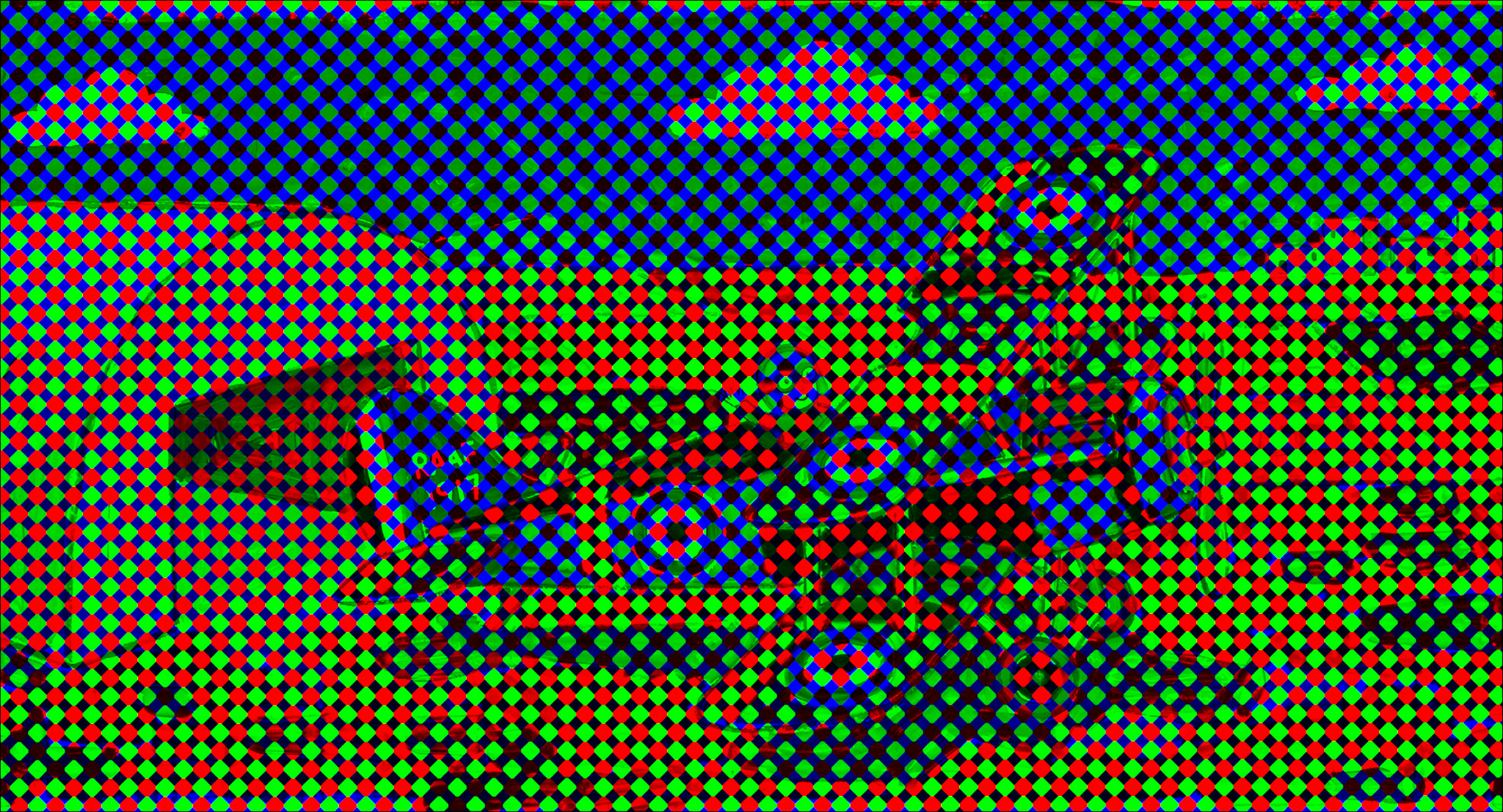
The principle of mosaic additive photography returned with digital cameras. A CCD or CMOS sensor consists of a grid of light-sensitive elements which do not, by themselves, distinguish colour. In front of them lies a colour filter array — most commonly a Bayer filter — strikingly similar in concept to the screens used by Paget and Finlay. Each sensor element therefore measures only one colour component. Software calculates the other two during a process known as demosaicing and constructs a full-colour image.

This similarity is precisely why modern digital methods are so useful for early screen photography. A computer can do what was mechanically extraordinarily difficult a century ago: work with millions of tiny elements, measure their positions and assemble them into an image.

A century-old screen negative can therefore be compared, with some licence, to an analogue RAW file. The colour image is not yet finished, but the data needed to construct it often still exist. This idea lies behind the Color-Screen project. Its first version was written rapidly for a 2013 exhibition at the Šechtl & Voseček Museum of Photography, after Mark Jacobs recognised Finlay Colour negatives in the digitised Matson Collection at the Library of Congress. Jan Hubička then spent several nights writing the first program capable of reconstructing an approximate colour image from them.

Today’s Color-Screen project goes much further. The aim is not merely to obtain an attractive colour picture, but to answer as accurately as possible a historical question: what might the photograph have looked like when it was made?

1. High-quality digitisation

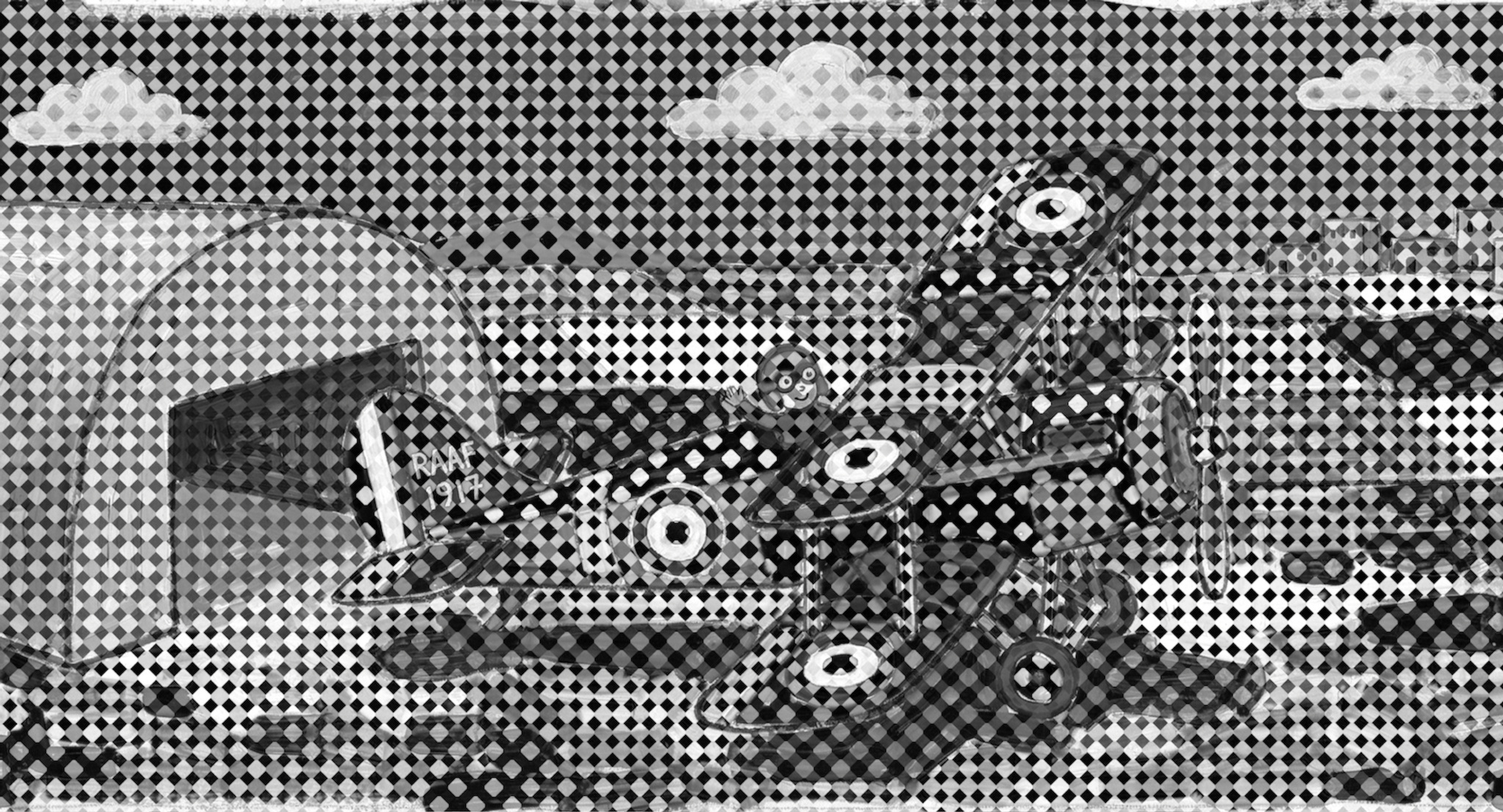
The original photograph must be digitised in a way that preserves as much as possible of the information encoded in its fine screen. This requires very high resolution — 150 megapixels or more. For transparencies with a surviving colour screen, imaging in infrared light is especially useful: the dyes of the screen almost disappear, leaving primarily the black-and-white silver image.

2. Locating the colour screen

This sounds easier than it is. The screen of a Paget, Finlay or Dufaycolor photograph is regular, but a scan is not a perfect geometrical copy of the photographic material. A plate may be slightly rotated; film may have shrunk over many decades; the emulsion may have distorted; and the scanner or reproduction lens introduces its own optical errors. Large originals are also often digitised by stitching several separate captures together.

Color-Screen therefore first determines the geometry of the screen: its pitch, rotation and exact position relative to the photographic image. It is not enough to know that the squares are, for example, approximately a tenth of a millimetre apart. An error of a fraction of one coloured element can already turn a red measurement into a green one and create false colours. Registration must therefore adapt continuously to local deformation across the original.

3. Compensating for blur in the digital reproduction

Even an excellent macro lens cannot reproduce a very fine colour screen perfectly. A small amount of blur reduces the contrast of the pattern — and with it the saturation of the reconstructed colours. Color-Screen therefore estimates the blur introduced by the lens and digitisation equipment and carefully compensates for this loss.

4. Simulating the photographer’s darkroom

If the photograph survives as a negative, another step must be reproduced: the historical laboratory process in which the negative was copied onto a black-and-white transparency. The model uses measured properties of photographic materials together with digital simulations of film behaviour similar to techniques used today in visual-effects production.

5. Demosaicing

Demosaicing turns the samples recorded beneath individual coloured screen elements into a continuous image and removes the distracting structure of the screen. Only then can the photograph be displayed well on a monitor or printed on paper. Modern image-processing algorithms are therefore being applied to information that the historical photograph encoded optically.

6. Estimating the original colours of the filters

To approach the original appearance, we must also know the colours of the screen itself when it was new. Work on this problem continues. For Dufaycolor, however, historical colorimetric measurements have been found in the CIE 1931 system, a standard still used today. These data allow us to estimate how the original screen differed from the faded one that survives.

Collaboration

Jan Hubička works on the project together with his students Linda Kimrová and Melichar Konečný. The project would not be possible without collaboration with institutions and companies including the American Museum of Natural History, Digital Transitions (DT Heritage), the Franklin D. Roosevelt Presidential Library and Museum, the Library of Congress, the National Geographic Society, the State Library of New South Wales and Zeutschel GmbH. We also thank specialists in historic photography for consultation and assistance with the research: Luisa Casella, Janine Freeston, Hanin Hannouch, Mark Jacobs, Bertrand Lavédrine, Sylvie Pénichon, Alice Plutino, Giorgio Trumpy and Gawain Weaver.

The exhibition presents only a small sample of the photographs that have so far been located, digitised to a sufficiently high standard and reconstructed. Collections of early colour photography are often small, forgotten and dispersed among museums and libraries around the world. Alongside continued development of reconstruction methods, one aim of the project is therefore to create as complete a catalogue as possible of surviving photographs and to work with institutions on their high-quality digitisation. Other colour photographs may still be waiting in archives, looking today like nothing more than black-and-white negatives.